FloorTone › Background noise & handle time
Silent seconds, real money
Background Noise and Average Handle Time
The short version: background noise taxes average handle time in seconds — a repeat-request here, a misheard digit there — and seconds at floor scale are payroll. On a 200-seat reference floor, our model puts the yearly cost of noise at $62,400 in the light scenario and $208,000 in the heavy one, against a published software benchmark of $180 per seat per year. Every assumption is printed below and the arithmetic ships as a script you can rerun with your own numbers. No black box, no vendor math.
The mechanism: where the seconds come from
Noise converts to handle time through four channels, all of them visible in call recordings:
- Repeat-request loops. "Sorry, could you say that again?" — in either direction. Each loop costs the question, the answer, and usually a confirmation. Inbound noise (the caller's side) drives more of these than most teams expect; that's the case for two-way noise cancellation.
- Verification re-asks. Names, digits, security answers heard through noise get read back and corrected. Failed verification is the expensive tail.
- Defensive holds. Agents park callers to escape a loud moment — a lawnmower outside a WFH window, a burst on the floor. The hold is noise-attributable AHT wearing a disguise.
- After-call rework. A misheard address caught later becomes a callback: a second call that exists only because the first one was noisy.
The model, with its assumptions showing
Reference floor: 200 seats × 40 handled calls per agent-day = 8,000 calls/day, fully loaded agent cost $18/hour, 260 production days a year. The one number you should argue with is the noise-attributable seconds per call, so we model three, and you should replace them with your own QA data (the A7 defect code in our metrics guide counts exactly this):
The other two inputs: $18 an hour fully loaded, and 260 production days a year.
| Scenario | Sec/call | Agent-hours/day | Cost/day | Cost/year | Per seat/year |
|---|---|---|---|---|---|
| Light | 6 | 13.3 | $240 | $62,400 | $312 |
| Moderate | 12 | 26.7 | $480 | $124,800 | $624 |
| Heavy | 20 | 44.4 | $800 | $208,000 | $1,040 |
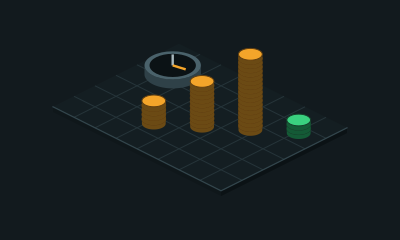
Amber bars: the Per seat/year column of the table above, output of tools/aht-model.py. Green line and bar: $15 per agent a month billed annually, or $180 a seat a year.
These figures were computed, not typed: the model is a 40-line Python script that ships with this site (tools/aht-model.py), and the table above is its verbatim output. Change the seat count, the wage, or the seconds, and it recomputes your floor.
The comparison line: the published list price for the dedicated software layer — Krisp CC Core at $15 per agent/month billed annually, verified — works out to $180 per seat per year. Against $312–$1,040 per seat of modeled noise cost, the software doesn't need to eliminate the problem to pay for itself; it needs to remove a little over half of the light scenario's cost ($180 of $312), and under a third of the moderate one ($180 of $624). That arithmetic is exactly the kind of claim you should verify on your own floor rather than take from us — which is why the pilot design in the ops guide comes before any annual contract.
The honest caveats
Three ways this model can mislead you if used carelessly:
- The seconds are the whole argument. If your real noise-attributable time is 2 seconds per call, the light scenario overstates your problem threefold. Measure first: two weeks of A7/A2 tagging gives you a defensible per-call figure.
- Saved seconds aren't automatically saved dollars. Freed capacity becomes money only when erlang math turns it into fewer required seats or absorbed growth. On a small queue, 13 agent-hours a day may just soften service levels — valuable, but a different sentence in the business case.
- Noise isn't your only AHT problem. If systems are slow and scripts are bloated, noise might be the third-biggest tax on your handle time. The model prices one tax; it doesn't rank them.
Model questions
Where does the 6–20 seconds range come from?
They're modeling scenarios, not measurements — deliberately spread wide so your own tagged data picks the row. We'd rather hand you a transparent range than a fake-precise industry average with no citation behind it.
Shouldn't we model CSAT and attrition too?
Probably — noisy calls degrade both, and both are more expensive than seconds. We left them out because the AHT channel is the one you can measure in two weeks with a QA form. Treat this model as the floor of the cost, not the ceiling.
Our client pays per call, not per hour. Does the model still apply?
Yes, with a twist: in per-call pricing, noise seconds eat your margin instead of your client's budget — which makes the per-seat comparison sharper, not weaker. Swap the hourly cost for your per-minute margin and rerun the script.