Audio ops for the people who own the queue
Call center audio clarity, from the floor up
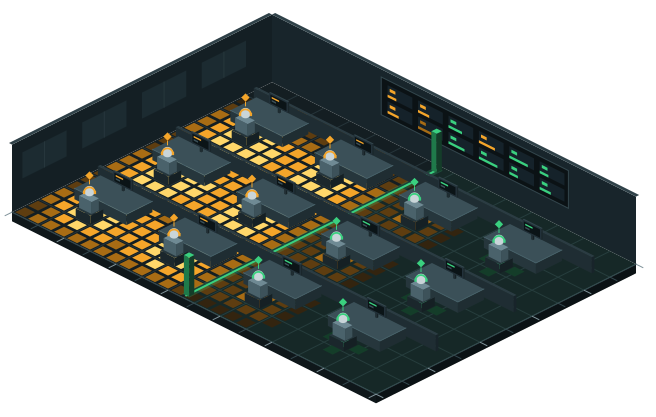 1Noise heat, no suppression yet2Suppression switched on3Heat shrinks to the seat
- Noise heat, no suppression yet
- Suppression switched on
- Heat shrinks to the seat
Start with the ops guide Run the handle-time math
FloorTone is an independent site about one narrow, expensive problem: the sound quality of your agents' calls. Background noise, cross-talk, muffled WFH setups, callers who can't be understood — we treat all of it as an operations problem with measurable costs, and we test the claims vendors make against their own published documentation, with the date we checked printed next to every fragile fact.
What we cover
Six working guides, one blog, zero fluff. Everything is written for team leads, WFM planners, BPO account managers and the agents themselves — not for consumers shopping for gadgets. We cover software and settings only; we don't review or recommend hardware.
Noise cancellation, the ops guide
The three layers that actually cut background noise, current per-agent pricing, and the rollout traps. Our cornerstone.
Krisp for call centers
The dedicated CC product line explained: what CC Core includes at its published per-agent price, what's quote-only, and the questions for sales.
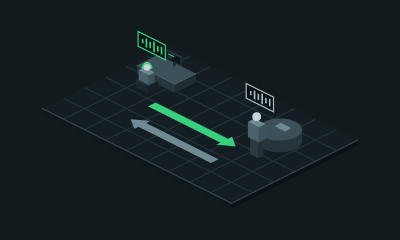
Accent clarity tools
Real-time intelligibility tooling, covered respectfully: what accent conversion does, what it must never be used to imply, and how to pilot it with agents in the room.
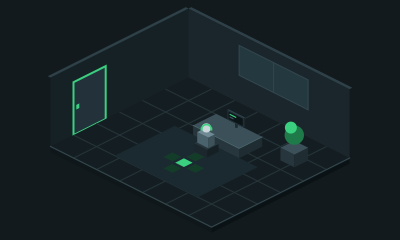
WFH agent audio
A team lead's standard for remote agent sound: environment, settings, software — plus a household-noise policy you can copy.
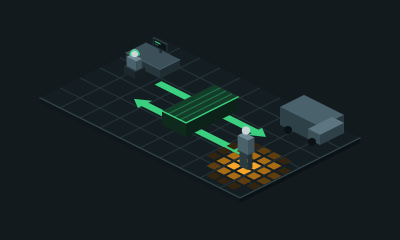
Two-way noise cancellation
Your agents lose more minutes to the caller's noise than to their own. The inbound half of the problem, explained.
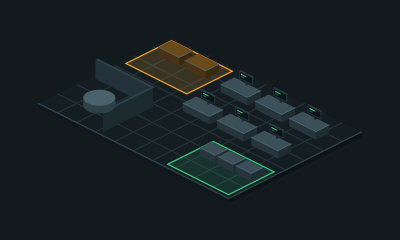
Open-floor background noise
What operations can genuinely control on a dense floor without a facilities budget — and what only software can catch.
Who this site is for
Four readers, one problem. Team leads and supervisors get the coaching-adjacent material: the defect codes, the WFH standard, the listening exercise that turns "your audio was bad" into something specific and fixable. WFM and ops managers get the money math — per-seat pricing verified against vendor sites, and a cost model whose assumptions are printed rather than implied. BPO account and deal teams get the contract side: what clients are writing into RFPs and how to answer without signing up for the weather. And agents themselves — especially the remote ones — get policies designed to be livable, because every standard on this site was written on the assumption that the person on the headset is a professional in a real household, not a problem to be managed.
- Team leads and supervisorsdefect codes, the WFH standard, the listening exercise
- WFM and ops managersper-seat pricing and a cost model with its assumptions printed
- BPO account and deal teamsthe RFP and contract side
- Agents, remote ones especiallypolicies written to be livable
If you're none of these — if you're shopping for a quieter headset or trying to fix a noisy podcast recording — you're in the wrong place, and we'd rather tell you that on day one than pretend to be everything.
Audio is an ops metric, not an IT ticket
Bad audio shows up in your numbers before it shows up in your inbox. Every "sorry, could you repeat that?" is silent seconds added to average handle time; every muffled agent is a CSAT comment waiting to be written; every noisy floor recording is a QA dispute. We wrote the arithmetic out in plain numbers in background noise and handle time, and we keep a working list of audio quality metrics that survive contact with a QA calibration session.
From the table on background noise and handle time (200-seat reference floor). Green: the $180 a seat a year software list price.
For BPOs the stakes are contractual: enterprise buyers now write audio standards into RFPs and quarterly reviews. Our guide to BPO client audio requirements maps the clauses we're seeing and how to answer them without over-promising.
How we verify
Three house rules, enforced on every page:
- Dated facts. Any price, plan limit or product claim carries the date we last checked it against the vendor's own site. If we couldn't confirm something on the live web, we say so instead of printing it.
- Docs-based claims only. We describe what vendors publish and what the deployment model implies. We don't invent benchmarks, and vendor-reported results (a "99% NPS increase" on a marketing page) are always labelled as the vendor's numbers, not ours.
- Disclosed money. Affiliate links are marked where they appear and never change a conclusion. At least one recommendation on this site — turn on your platform's built-in suppression and baseline it — pays us nothing by design.
Quick answers
What does call-center noise cancellation cost right now?
The published anchor, verified 20 September 2026: $15 per agent per month billed annually for Krisp's CC Core plan. Enterprise tiers with accent conversion, translation or analytics are quote-based across the market. Full picture in the ops guide.
Do these tools need telephony changes?
No — the agent-side model installs on the agent's machine as a virtual audio device between headset and softphone, which is why pilots take days rather than quarters.
Is accent conversion about "fixing" agents?
No, and we won't cover it that way. It's real-time intelligibility tooling — an accent is not a defect, and the serious vendors position the technology bidirectionally: it helps agents understand customers too. Our accent clarity guide sets out the framing and the consent questions to settle before any pilot.
Fresh from The Wrap-Up
Shorter pieces from the floor — the blog is called The Wrap-Up, after the note you type when the call ends.
- Night shift audio: keeping calls quiet at 3 a.m. — the graveyard queue has its own physics.
- The dog on the call — pets, agents, and what policy should actually say.
- What the caller actually hears — an uncomfortable listening exercise for team leads.