FloorTone › The Wrap-Up › Night shift audio
The Wrap-Up
Night Shift Audio: Keeping Calls Quiet at 3 A.M.
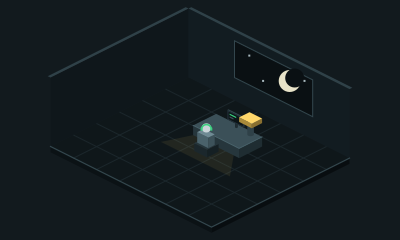
The night queue inverts the noise problem. Day-shift audio is about keeping the world's noise out of the call. Night-shift audio is about keeping the call's noise out of the world — because at 3 a.m., a WFH agent isn't fighting the household for quiet; the agent is the household's noise. That inversion changes what good setup, good policy and good software mean, and almost nobody writes it down.
Day shift
Keep the world's noise out of the call.
Night shift
Keep the call's noise out of the world: the agent is the household's noise.
The agent is the loudest thing for a mile
A support call runs at conversation volume, hour after hour, in a flat where everyone else is asleep. Night agents know the consequences intimately: the partner who has to be up at six, the toddler whose room shares a wall, the neighbour who has started timing the noise for the building group chat. So they adapt — by whispering. And whispering is an audio defect: low signal, breathy texture, compressed dynamic range. The caller strains, asks the agent to repeat, and the agent — trying not to wake anyone — repeats quietly again. That loop is our A4 defect code ("agent voice low, distant or muffled") wearing pyjamas; the full code list is in the metrics guide.
The honest fix is not "speak up." It's a setup where normal-adjacent speech is possible: the room farthest from sleepers, a door that closes, mic close enough that a low-but-voiced register still reads full — close-mic'd quiet speech sounds dramatically better than distant-mic'd quiet speech, because the signal-to-room ratio is what callers actually hear.
What the night gives back
Night shifts do hand you one gift: the unpredictable noise events that plague day WFH — deliveries, school runs, the neighbour's mower — mostly sleep too. Ambient scores at night are typically the cleanest of any shift. Which produces the night-audio paradox: outbound cleanliness is nearly free at 3 a.m., while the hard problems move to the agent's own voice level and to the inbound side. Night callers skew toward exactly the environments software exists for: drivers on empty highways, warehouse and hospital staff on breaks, travelers in airports where it is very much not 3 a.m. Cleaning what your agent hears is the two-way noise cancellation case, and it's arguably stronger on nights than days.
Three policies that respect the night
- Voice-level amnesty, setup accountability. Never coach a night agent to "project more" without first funding the room change that makes projection possible. Volume advice into a sleeping household is policy malpractice.
- Schedule the loud work. Outbound blocks, escalation callbacks and anything script-heavy belong at the shift's edges, when households are more awake. WFM can move noise in time on nights exactly as it does on the day floor.
- Let the software carry the margin. A noise-cancellation layer won't make a whisper loud, but it strips the 3 a.m. artifacts — fridge hum, fan noise, the creak-and-rustle of a quiet room — so a low-voiced agent spends every decibel on speech. The deployment math is the same as any seat; see the ops guide.
The wrap
Night agents are running the hardest audio brief in the company: be clearly audible and nearly silent, simultaneously, for eight hours. Treat their setup requests as engineering requirements, not comfort items. And if you run QA calibration, score a batch of night calls as their own cohort at least once — the defect mix is so different from days that a single blended threshold quietly punishes the people working while you sleep.
Related reading: the full WFH agent audio standard — the household-noise policy template there includes the scheduling clause night teams rely on.