FloorTone › Call center noise cancellation
The money question, answered like an ops problem
Call Center Noise Cancellation
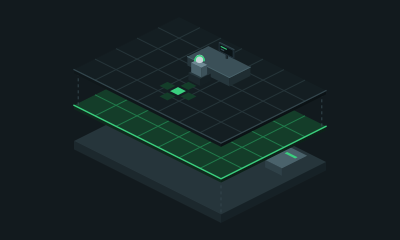
The short version: in 2026, call centers cut background noise with three layers — the suppression already built into the CCaaS platform, a dedicated agent-side AI audio layer, and plain floor policy. The middle layer is where the real gains live: modern agent-side software removes noise in both directions, installs without touching your telephony stack, and is priced per agent per month. This guide covers what each layer does, what it costs, and where rollouts go wrong.
Prices and product limits on this page were checked against vendor websites on . Vendors change terms without notice — re-verify before you sign anything.
What "noise cancellation" means on a call floor
On a call floor, noise cancellation means software that strips non-speech sound from the call audio in real time — not headsets, and not foam panels. It is worth being precise, because vendors sell three distinct capabilities under one phrase:
- Agent-side noise cancellation. Removes the sound around your agent — neighbouring agents, keyboards, the WFH agent's household — before it reaches the caller. This is the capability clients complain about when it's missing.
- Customer-side noise cancellation. Cleans the inbound audio, so your agent isn't deciphering a caller who is driving, cooking, or standing in a warehouse. This is the half that quietly shortens handle time; we cover it fully in our guide to two-way noise cancellation.
- Voice isolation. A stricter mode that passes only the agent's own voice and rejects other voices, not just mechanical noise. On dense floors where the loudest background sound is other agents talking, this is the feature that matters — ordinary suppression is trained to keep human speech.
Krisp, the most visible vendor in this category, lists all three as separate line items on its call-center plans: "Agent Noise Cancellation," "Customer Noise Cancellation," and "Agent Voice Isolation" (verified on krisp.ai's pricing page, 20 September 2026). When you evaluate any vendor, ask which of the three you are actually buying.
The three layers, and the order to try them
Deploy in order of cost: built-ins first, dedicated software second, policy always. Each layer catches what the previous one can't.
- Layer 1 · Platform built-insCost: nothing. Turn on what you already pay for and baseline it.
- Layer 2 · Agent-side softwareCost: per agent per month. Installs on the agent’s machine; no telephony changes.
- Layer 3 · Floor and household policyCost: management attention. Density, WFH standards, desk placement.
Layer 1: what your platform already does (cost: nothing)
Most contact-center platforms now ship some basic noise reduction in the client or in the media path. Quality varies widely, and voice isolation — rejecting other people talking — is rarer than simple hiss removal. Before you spend a dollar per seat, turn on what you already pay for, run it for two weeks, and log QA audio scores and repeat-request rates. That baseline is what makes the next decision honest. This recommendation earns us nothing, which is exactly why it comes first.
Layer 2: a dedicated agent-side audio layer (cost: per agent per month)
The dedicated tools install on the agent's machine and register as a virtual microphone and speaker. The softphone sees a clean device; the software does its work in between. Krisp describes its contact-center deployment as sitting "between the agent's headset and your CCaaS/UCaaS stack — processing every call in real time, with no telephony integration required," and names Genesys, Five9, Amazon Connect, Talkdesk, Avaya, Vonage, RingCentral, 8x8, Aircall and Twilio among compatible platforms (krisp.ai/call-center, read 20 September 2026). The practical consequence: a pilot needs desktop-install rights and nothing else. No SIP changes, no carrier tickets, no platform migration.
- Headsetthe agent's own mic and ears
- Agent-side layera virtual microphone and speaker on the agent’s machine
- Softphone / CCaaSsees a clean device; no telephony changes
- Callerhears the agent, not the room
Where a tool processes both directions, one install does both: the agent’s room on the way out, the caller’s room on the way in. Not every product does; ask.
Layer 3: floor and household policy (cost: management attention)
Software removes noise from the signal; it does not remove it from the room. Agents sitting in 75 dB of colleague chatter still tire faster, still mis-hear callers, and still lean into their mics. Pair the software with density limits, respectful WFH setup standards, and sane escalation-desk placement. Our guide to open-floor background noise covers what ops can genuinely control without touching facilities budgets.
What it costs in 2026
Here is the pricing picture we verified on 20 September 2026, in one table. Quote-based means the vendor publishes no number — budget from your seat count and negotiate.
| Option | Published price | What it covers | Notes |
|---|---|---|---|
| CCaaS built-in suppression | $0 extra | Basic noise reduction; capabilities vary by platform | Already in your stack — the honest baseline. Check your admin console. |
| Krisp CC Core | $15 per agent/month, billed annually | Agent noise cancellation, customer noise cancellation, agent voice isolation, usage analytics | Self-evident per-seat math; prepaid trial offered. See our Krisp for call centers breakdown. |
| Krisp CC Advanced | Quote-based | Adds accent conversion, voice translation, speech analytics, voice security | Requires an evaluation sign-up with sales. |
| Sanas (Speech Enhancement) | Quote-based | Real-time speech enhancement and accent translation for contact centers | Enterprise sales motion. We have no affiliate relationship with Sanas. |
Krisp CC Core, billed annually, as verified on 20 September 2026. Quote-based tiers are not in this sum.
Run the math against your seat count before the demo call, not after. At $15 per agent per month billed annually, a 200-seat floor is $36,000 a year — real money, but small next to a single lost client logo or a point of attrition. The comparison that matters is not "software vs. free"; it's "software vs. what noise is already costing you," which is why we wrote out the handle-time math separately.
How the cleanup works, in plain language
Modern noise cancellation is a small neural network that learned, from enormous amounts of audio, what human speech looks like versus everything else. On every fraction of a second of your call, it estimates which parts of the signal are voice and which are keyboard, compressor hum, or the row behind your agent — and it rebuilds the outgoing audio with only the voice. This is why the current generation is categorically different from the "noise gate" era your senior engineers remember: a gate simply muted the channel below a volume threshold, which is why old systems clipped soft-spoken agents and let loud floors straight through. Model-based suppression works at any volume, in both directions, on sounds it has never heard in your specific room.
Three practical consequences follow. It runs on the agent's machine, so audio does not detour through a vendor's cloud for cleanup on the products built this way. It consumes real CPU, which is why we keep telling you to pilot on your worst hardware. And it is probabilistic — extremely good, not perfect — which is why overlapping speech (a bark during a word, a neighbour talking over your agent) remains the hardest case and why voice isolation exists as a distinct, stricter mode.
Where the noise actually comes from
Call-center noise splits into four sources, and each one implicates a different fix. Diagnose before you buy:
- Other agents. The dominant source on any open floor — and the hardest for standard suppression, because it is human speech. This is the case for voice isolation, not just noise cancellation.
- The agent's household. Children, pets, traffic, shared flats. Since hybrid staffing became permanent, this is a policy and software problem: our WFH agent audio setup guide includes a household-noise standard you can copy into your remote-work agreement.
- The caller's environment. You cannot policy your customers. Inbound cleanup is a software capability, full stop — see two-way noise cancellation.
- The equipment chain. Hum, hiss and echo from cheap audio paths and double-processing. Note our lane: FloorTone covers software and settings, not hardware purchasing — if a headset is physically broken, no algorithm rescues it.
Rollout pitfalls we'd plan around
The pattern that works is pilot, measure, then scale — and most failed rollouts skipped step two. Specific traps:
- Double processing. If the dedicated layer and the platform's built-in suppression both run, you can get artifacts and a "underwater" voice. Pick one processor per direction and disable the rest.
- Thin clients and VDI. Agent-side tools are desktop applications; virtual desktop setups need explicit vendor guidance and a real proof-of-concept, not an assumption.
- CPU headroom. Real-time inference costs cycles on machines that are often the cheapest on the org chart. Pilot on your worst hardware, not your best.
- Silent config drift. Agents can usually toggle the tool. Decide up front what is locked, what is monitored, and what the usage analytics need to show your WFM team.
- No baseline. If you didn't capture QA audio scores, repeat-request rates and handle time before the pilot, the renewal debate becomes a matter of opinion. Our agent audio quality metrics guide lists what to log.
Two playbooks: 50 seats and 500 seats
The 50-seat floor
Skip the RFP theatre. Enable platform built-ins this week and baseline for two weeks. Then trial an agent-side layer on your noisiest team — Krisp's call-center plans offer a prepaid trial, so the evaluation has a fixed, small cost. Compare QA audio-defect rates before and after, and let the numbers make the renewal decision. Total elapsed time: about six weeks.
- This weekswitch on the platform built-ins
- Two weeksbaseline QA audio scores and repeat requests
- Trialan agent-side layer on the noisiest team, on a prepaid trial
- Decidecompare audio-defect rates; about six weeks end to end
The 500-seat BPO
At BPO scale the driver is usually a client requirement, not internal preference — enterprise clients increasingly write audio standards into their RFPs and SLAs. Structure the pilot so its output is client-facing evidence: one queue, one client program, defect codes logged by QA, a before/after pack you can put in a QBR deck. Negotiate per-agent pricing at volume; published list prices are a starting point, and quote-based tiers exist precisely because large floors negotiate.
One more note for hybrid floors, which is now most floors: run the pilot across both populations deliberately — a proportional slice of on-site seats and WFH seats, not whichever was easier to install. The two environments fail differently (cross-talk and floor rumble on-site; transient household events remote), and a pilot that skipped one of them will be re-litigated at renewal by whoever's population wasn't measured.
Questions ops teams actually ask
Does it work on the customer's side too?
Yes, if the tool processes inbound audio. Krisp's call-center plans list agent-side and customer-side cancellation as separate features; the customer-side half is the one that shortens repeat-and-confirm loops. Not every product in the category does both — ask explicitly.
Do we need telephony integration?
Generally no. The agent-side model is a virtual audio device between headset and softphone, which is why it deploys in days. Krisp states its contact-center product needs "no telephony integration" (krisp.ai/call-center, read 2026-09-20).
What does it cost per agent?
The published anchor as of 20 September 2026: $15 per agent per month, billed annually, for Krisp CC Core. Everything above that tier — accent conversion, translation, analytics — is quote-based across the market.
Will it fix a loud open floor by itself?
It fixes what the caller hears, which is most of the business damage. It does not lower the decibels your agents sit in — density, seating and break policy still carry that load.
Should we try free options first?
Yes. Built-in platform suppression costs nothing and sets your baseline. If it closes the gap, stop there; if QA scores say otherwise, you now have the numbers that justify a per-agent line item.
Where to go next
Krisp for call centers
The CC plans, feature by feature, with the questions to ask sales.
Two-way noise cancellation
The customer-side half nobody budgets for — and why it moves AHT.
Prove it moved the needle
The audio metrics that survive a QA audit and a renewal debate.