FloorTone › Noise and speech analytics
Your QA scores are only as clean as the audio
Background Noise and Speech Analytics
The short version: background noise does not just annoy callers; it changes what your speech analytics thinks was said. Recognition engines drop words, invent words and, on open floors, credit a neighbour's voice to your agent. Those errors flow downstream into keyword spotting, sentiment and compliance checks, so a disclosure the agent did read can be scored as missing. Vendors quote accuracy figures for this, mostly without sources. The useful number is your own, and you can measure it on 50 of your own calls in about a week, with no vendor involved.
This page explains a mechanism and a test method; it quotes no accuracy percentages, because none we found had a primary source. Vendor product facts are dated where they appear.
How noise turns into transcript errors
Speech recognition makes three kinds of mistake, and the standard accuracy measure counts all three. A deletion is a word the engine missed, typically one masked by a door, a siren or a laugh. An insertion is a word that was never said, often conjured out of a burst of noise. A substitution is the wrong word in place of the right one, the most common result when a word is partly drowned out. Word error rate adds the three together and divides by the number of words a careful human transcriber heard.
Phone audio makes every one of these more likely. Calls are compressed, the caller's environment is unknown, and agents talk fast. None of that is controllable at QA time. What a floor does control is the agent's side: the noise around the microphone when the recording is made.
The background-voice problem on open floors
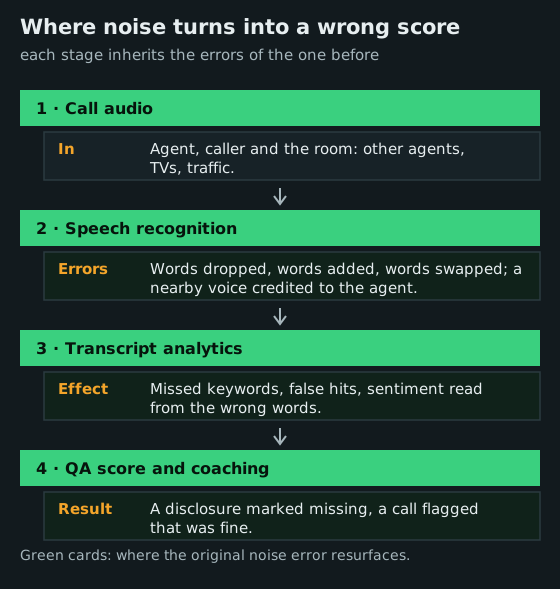
Steady noise is the easy case. Fans, air conditioning and street hum sit in frequencies that modern suppression removes well, and engines cope with them. The hard case is other people talking. To a recognition engine, the agent at the next desk saying "can I take your card number" is speech, and a clear agent-side channel may carry enough of it to be transcribed.
Two things then go wrong. The transcript gains sentences your agent never said, which can trip compliance keywords or skew sentiment. And the timing of turns gets muddled, so talk-over and silence metrics drift. Floors that seat agents close together, or that mix outbound sales and inbound support in one room, see this most. The operational fixes are in our open-floor guide; the software fix is voice isolation, which keeps only the agent's own voice rather than all speech.
What that does to QA scores, sentiment and compliance
Every automated QA rule is built on the transcript, so every transcript error is a potential scoring error. Three patterns are worth looking for in your own data:
- False misses on scripted lines. A required disclosure is read correctly but a few masked words stop the phrase matcher from finding it, and the call fails a compliance check.
- False hits. A keyword picked up from a neighbour's call, or invented from noise, triggers an escalation or a coaching flag on a call that was fine.
- Sentiment drift. Sentiment models score words. Missing or wrong words shift the score, and a noisy caller environment can make a calm call look tense.
None of this shows up as an obvious failure. It shows up as agents on noisy desks or noisy shifts scoring slightly worse, month after month, for reasons nobody can see in the transcript. That is a fairness problem as much as a data problem, and it is why we connect this page to our audio quality metrics: defect codes on the audio side explain variance on the QA side.
Test your own engine: a 50-call protocol
You do not need a vendor's benchmark. You need two piles of your own calls and a human with headphones. Here is the method we suggest, and the worksheet that goes with it:
- Sample 50 recorded calls from one queue and one month, spread across agents and shifts. Have a listener rate each call's background as quiet, some noise or heavy noise without looking at QA results.
- Transcribe a two-minute excerpt of each call by hand, choosing a stretch that contains a required phrase if your script has one.
- Score the engine's excerpt against the human one: count substituted, deleted and inserted words and divide by the human word count.
- Check the rules the way QA does: was the required phrase detected? Was any sentence credited to the agent that a different person said?
Then compare the quiet band with the heavy band. If the medians are close and disclosures are found in both, your engine copes and noise is a comfort problem, not a data problem. If the heavy band's error rate is clearly higher, or its disclosures go missing, you have found a scoring bias you can show to operations and finance.
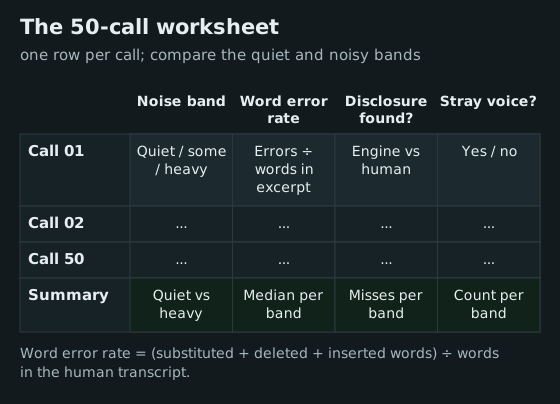
Fifty calls is enough to see a large effect, not a subtle one. If the result is borderline, double the sample before you spend money. And keep the worksheet: it becomes your baseline for checking any noise tool you trial later.
Where to put suppression: before capture, or after
The order of operations decides whether noise suppression helps your analytics at all. If the agent's audio is cleaned on the desktop before the platform records it, the recording, the transcript and every score built on it inherit the cleaner signal. If suppression only touches what the caller hears live, or is applied to the recording afterwards, your analytics may still be working from the noisy version.
So ask your platform and any third-party vendor the same question in writing: is the recording made before or after the noise processing? Agent-side desktop layers such as Krisp sit between the headset and the platform, which places them in front of the recording, but confirm it on your own stack by listening to a recording made with the layer on. Krisp also sells speech analytics in its own call-center line, which its pricing page describes as AI analysis of 100% of calls; we have not tested it, and the 50-call method above works the same on any engine.
The customer side is harder. Inbound cleanup can make it easier for agents to hear, but whether it improves the recorded customer channel depends on where your platform captures that channel. Our page on two-way noise cancellation covers the inbound half.
Quick answers
Does background noise affect speech analytics accuracy?
Yes. Noise causes missed, added and wrong words in the transcript, and background voices can be credited to the agent. Every analytics rule built on the transcript inherits those errors.
How much does noise reduce transcription accuracy?
It depends on your engine, your audio and your floor, which is why we do not quote a figure. Measure it on 50 of your own calls with the worksheet above.
Can noise make an agent fail a compliance check?
It can, if masked words stop the engine from matching a required phrase. Check a sample of failed disclosures by ear before treating them as agent errors.
Should suppression run before or after recording?
Before, if you want analytics to benefit. Confirm with your vendors in writing whether recordings are captured before or after their processing.
Is word error rate the right metric for QA?
It is a good start but not the whole picture. Pair it with the checks QA actually runs, such as disclosure detection and stray-voice attribution, because those decide scores.