FloorTone › Accent clarity tools
Intelligibility tooling — handled with care
Accent Clarity Tools for Support Teams
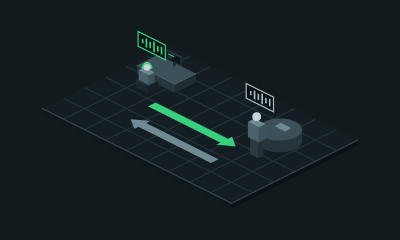
The short version: real-time accent conversion is software that re-shapes the pronunciation patterns of live speech while keeping the speaker's own voice, so that two people with different listening backgrounds understand each other faster. Used well, it is intelligibility tooling — the audio equivalent of subtitles, working both directions. Used badly, it becomes a message to your agents that who they are is a problem to be processed away. This guide covers what the technology does, who builds it, and the ground rules that separate the two outcomes.
Vendor facts on this page were checked against krisp.ai and sanas.ai on . Krisp links on this page are affiliate links, disclosed below; we have no affiliate relationship with Sanas.
First, the framing that keeps this honest
An accent is not a defect, and no tool on this page "fixes" anyone. Every human speaker has an accent; what varies is how much exposure the listener has had to it. A support call is two people with limited time and no shared room, often on compressed, noisy audio — the hardest possible listening conditions. Intelligibility tooling narrows the gap from both ends, and the serious vendors build it that way:
- Krisp ships accent conversion in two explicit directions — "Accent Conversion – Speaker side" and "Accent Conversion – Listener side" appear as separate features in its product navigation (verified 2026-09-20). The listener-side mode adapts incoming speech so your agent understands the customer faster. That symmetry matters: the technology helps the agent hear, not just be heard.
- Sanas, the other established vendor, calls the category "Accent Translation" and describes it as modulating accents in real time "while preserving voices and emotions." Its stated mission language centers on "removing communication barriers," and its site leads with "AI that enhances, never replaces, humans" (sanas.ai, read 2026-09-20).
Speaker side
Re-shapes the pronunciation of the agent’s outgoing speech; the voice stays the agent’s own.
Listener side
Adapts incoming speech so the agent understands the customer faster.
Krisp lists the two directions as separate features. Accent conversion sits in its quote-based CC Advanced tier.
If a vendor pitch — or an internal deck — describes the same technology as correcting, neutralizing or fixing agents, send it back. The words become policy, and the policy becomes how your agents are treated.
What the technology actually does
Accent conversion models re-map phoneme-level pronunciation in real time while preserving the speaker's vocal identity — pitch, timbre, pacing, emotion. It is not text-to-speech with a different voice; the output is recognizably the same person. Krisp's call-center page frames it as "softening accents bidirectionally while preserving each speaker's natural voice and authenticity," and lists support for Indian, Filipino, Latin American, Pakistani and African agent accents in English conversations (krisp.ai accent-conversion page, read 2026-09-20).
Two practical notes from the deployment model. First, this is real-time inference on live audio, so it ships inside the same agent-side desktop layer as noise cancellation — one install, one virtual device, covered in our Krisp for call centers breakdown. Second, it is an enterprise-tier feature: on Krisp's published plans, accent conversion sits in the quote-based CC Advanced tier, not the $15/agent CC Core plan (verified 2026-09-20). Sanas is quote-based throughout. Nobody impulse-buys this category, which is good — it deserves deliberation.
The two vendors, side by side
| Vendor | Product naming | Directionality | Pricing | Relationship to us |
|---|---|---|---|---|
| Krisp | "Accent Conversion" (part of Call Center AI / Speech Assist) | Bidirectional — speaker side and listener side sold as distinct features | CC Advanced tier, quote-based; individual Meeting plans include capped daily hours | Affiliate relationship, disclosed at the link below |
| Sanas | "Accent Translation" (with separate Speech Enhancement and Language Translation products) | Real-time modulation, voice- and emotion-preserving | Quote-based, enterprise sales | No affiliate relationship — linked because the comparison is incomplete without them |
Both vendors court the same BPO buyers, and both lean hard on privacy language — Sanas states it does not "monitor, record or store any call data" and lists HIPAA, SOC 2, GDPR, ISO 27001 and PCI DSS among its certifications (sanas.ai, 2026-09-20). Whichever you evaluate, have security review the actual data-processing agreement, not the badge wall.
Five ground rules before any pilot
The technology decision is the easy half. These are the rules we'd put in writing first:
- Agents in the room, from day one. The people whose voices pass through the model evaluate it first, hear their own processed output, and have a documented way to object. A pilot agents learn about from a QA form has already failed.
- Opt-in beats mandate. Start voluntary. If the tool genuinely reduces repeat-requests and call strain, agents will tell each other — adoption curves are your honest feedback channel.
- Never a hiring or scoring filter. The moment "conversion-compatible accent" appears anywhere near recruiting or QA scorecards, you have crossed from tooling into discrimination. Put the prohibition in the pilot charter explicitly.
- Decide your disclosure position deliberately. Callers hear a processed voice. Legal and brand teams should decide — on purpose, in writing — what the company says if asked, rather than leaving agents to improvise.
- Measure both directions. If you deploy speaker-side conversion but ignore listener-side comprehension aids, you've told agents the burden of understanding is theirs alone. Track repeat-request rates on both ends; our audio metrics guide shows where those numbers come from.
When it's worth evaluating — and when it isn't
Worth evaluating: high-volume voice queues where post-call surveys or QA notes show comprehension friction in both directions, and where you can fund a proper opt-in pilot with agent feedback loops. The upside vendors describe — Krisp's page talks about "reduced cognitive load" and supporting access to global talent — is real when the floor wants the tool.
Not worth it: as a substitute for basics. If your calls are noisy, fix noise first — it's cheaper, uncontroversial, and on Krisp's plans it's the $15 CC Core tier rather than a custom quote. Our call center noise cancellation guide is the place to start; most "I can't understand the agent" complaints turn out to be audio-quality complaints wearing a different hat. And if the underlying issue is training, scripting or product knowledge, no audio model will save the call.
Questions worth settling early
Does accent conversion change what the agent said?
No. It re-shapes pronunciation patterns, not words or meaning, and preserves the speaker's own voice character. It is not a synthetic replacement voice.
Is this only for offshore BPOs?
No — and assuming so gets the framing backwards. Listener-side modes help any agent understand any caller; comprehension friction exists on domestic queues too. It's a two-sided tool for a two-sided problem.
Can we just enable it quietly and see if metrics move?
Don't. Processing an agent's voice without their knowledge is corrosive to trust and, in some jurisdictions, legally fraught. Consent isn't a compliance chore here; it's the difference between tooling and imposition.