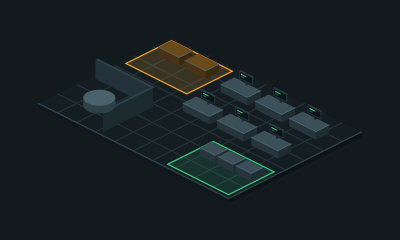
The short version: a dense call floor is loud because it is full of people whose job is to talk. Operations owns three levers that don't require a facilities budget: where the loud functions sit (zoning), when the loud moments happen (scheduling), and what the caller hears of any of it (voice-isolation software). Acoustic treatment — panels, ceilings, partitions — is real but belongs to facilities and capital planning; this page is about the part you can change this month. FloorTone covers software and operations, not construction.
Zoning
Where the loud functions sit.
Scheduling
When the loud moments happen.
Voice isolation
What the caller hears of any of it.
Why open floors are loud: the spiral
Call floors suffer a specific feedback loop: as ambient noise rises, every agent unconsciously raises their own voice to stay intelligible — the Lombard effect, documented in speech research for over a century. Forty agents each compensating for the other thirty-nine ratchets the whole room upward until the loudest hour of the day sounds like a departure lounge. Nobody is misbehaving; the room is simply doing math against you.
This matters for tool choice because the dominant background sound on a call floor is other human speech — the one thing ordinary noise suppression is explicitly trained to preserve. That's why the feature to evaluate for floors is voice isolation (pass one voice, reject other voices), not generic noise removal. The distinction, and current per-agent pricing, is laid out in our call center noise cancellation guide.
Lever 1: zoning — separate the loud functions
Most floors are laid out by team hierarchy, not by noise profile. Re-sort by sound and you get quieter calls for free:
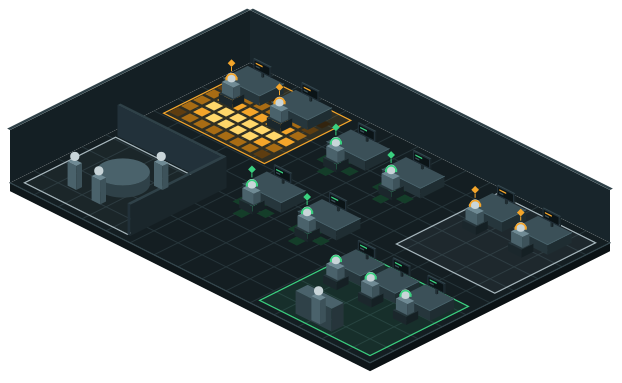
- Escalation and supervisor desks — away from the queue rows
- Queue rows — the inbound calls this protects
- Outbound team — its own zone
- Huddles and coaching — off the floor
- New-hire cohort — together, near their trainer
- Escalation and supervisor desks away from the queue rows. Escalation calls run long, loud and emotional — they are the floor's noisiest single sources, and they usually sit dead-center.
- Outbound teams in their own zone. Outbound talks in bursts and celebrates wins audibly (as it should — that energy is the job). Don't seat them behind an inbound support row.
- Huddles and coaching off the floor. A six-person standup beside live calls is a self-inflicted wound. If there's no room, huddle at shift edges.
- New-hire cohorts together, near their trainer, away from veterans. New agents talk louder and longer while scripts bed in — normal, temporary, and worth isolating kindly.
Lever 2: scheduling — move the noise in time
WFM already moves people through time; add noise as a scheduling input. Stagger breaks so the return-from-break chatter wave never coincides with peak call volume. Book team meetings and floor announcements into the quietest interval of the day (your CCaaS interval report will tell you where that is). Schedule cleaning, deliveries and maintenance outside core hours. None of this costs anything; all of it shaves decibels off the exact minutes when the most callers are listening.
Lever 3: software — control what the caller hears
Zoning and scheduling lower the room's noise; software controls how much of the remainder reaches the caller, and it's the only lever that can take that number to approximately zero. An agent-side layer with voice isolation passes the agent's voice and rejects the neighbours' — on Krisp's published call-center plans, "Agent Voice Isolation" is a named feature of the $15/agent/month CC Core tier, alongside cancellation in both directions (krisp.ai, verified ). Deployment is agent-machine software with no telephony changes; the rollout checklist lives in the ops guide, and the plan details in Krisp for call centers.
Try the zero-cost baseline first: whatever suppression your platform ships is already paid for, and two weeks of QA scores with it enabled tells you exactly how big the remaining gap is. That recommendation earns us nothing, which is why it keeps appearing on this site.
What software can't do for a loud floor
Be honest in the business case: agent-side software cleans the signal, not the room. Your agents still sit in the decibels all shift — still tire, still strain to hear callers, still absorb the departure-lounge hours. The caller-side half of that fatigue has a software answer (two-way noise cancellation cleans what agents hear), but the room itself is physics: density targets, headcount-per-square-meter decisions, and eventually acoustic treatment are facilities conversations. When a client audit flags "site noise" — increasingly common, per our BPO client audio requirements guide — bring both halves: software evidence for what callers hear, a facilities plan for what agents endure.
Floor questions
Our clients hear the floor on recordings. Which lever first?
Software, because it changes what recordings capture immediately; zoning second. Then use the before/after recordings as evidence in the next client review — the metrics guide shows how to package it.
Does voice isolation make agents sound isolated or robotic?
Run your own ears over it: record test calls on your floor during the loud hour, with and without. Modern isolation is good; your floor, your headsets and your codec are the variables no review can test for you.
Is there a "right" density number?
We won't invent one — it depends on ceiling height, layout and program type. The honest method: measure QA audio flags by row, and let your own floor tell you where density starts costing you.